We may be paid by providers listed here. It never affects our ratings.
Top Home Warranty.com
Best For30 min read

Best Home Warranty for Older Homes (2026): Expert Picks

The best home warranties for older homes: age rules, pre-existing and code coverage, boilers, R-22 AC, old wiring and pipes, costs and 7 companies compared.

Updated

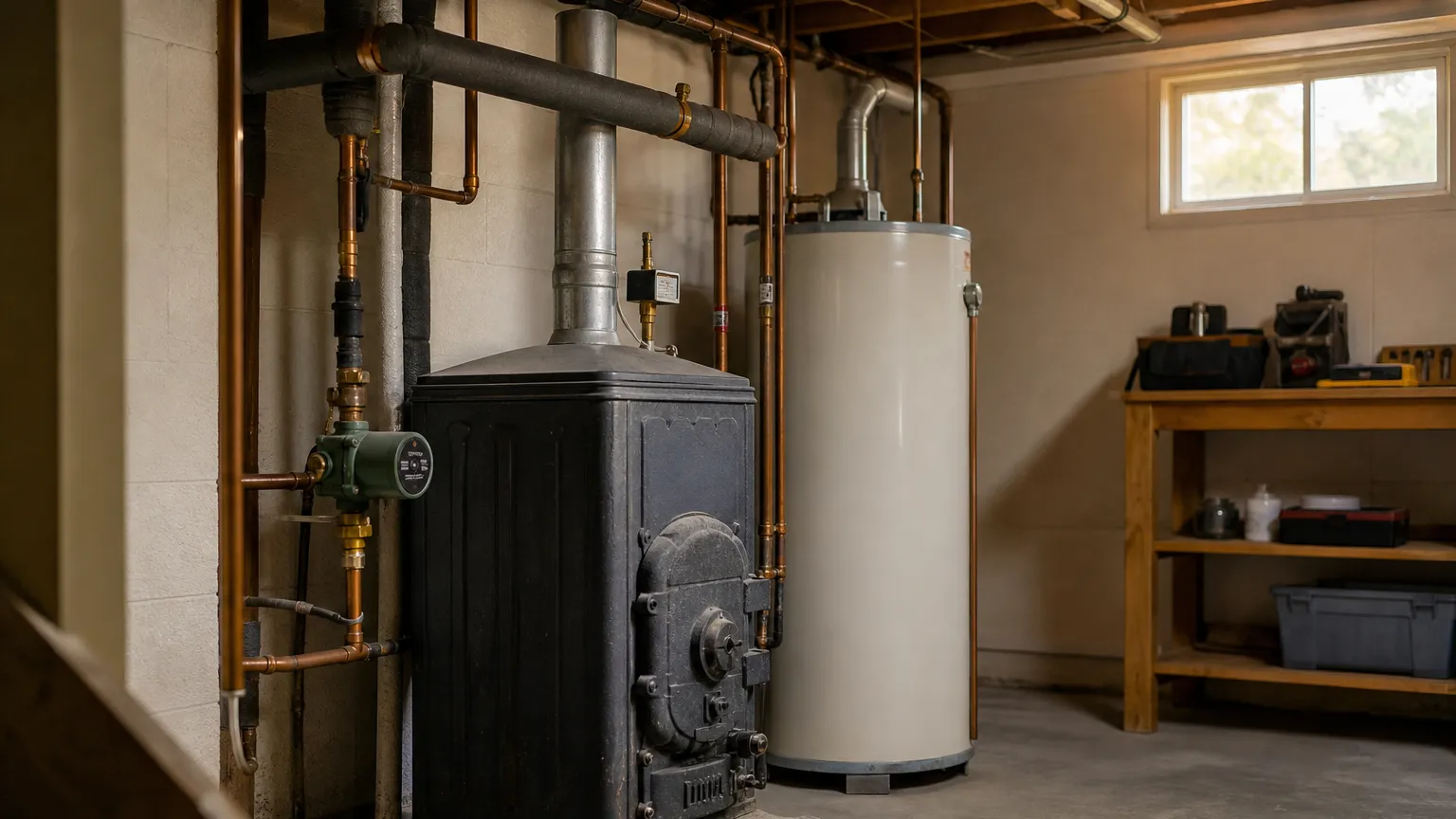
Older home basement with a vintage boiler, water heater, copper pipes, and a wooden workbench with tools.

Key takeaways

  • No major company excludes items for age alone - older-home claims are decided by pre-existing condition terms, code and permit coverage, sub-limits on equipment like boilers, and whether replacements are paid at depreciated value.
  • American Home Shield is our top pick for most older homes (any age, SEER and refrigerant-standard upgrades on HVAC replacement, rust and corrosion covered); First American is best for older HVAC and boilers where sold.
  • The median US owner-occupied home is 42 years old and about 47% were built before 1980 (NAHB, 2024 ACS) - so HVAC limits matter more than any other number in the contract.
  • No warranty pays to rewire knob-and-tube or aluminum wiring, replace an outdated panel, repipe or replace a sewer line - budget for those separately.

What is the best home warranty for an older home?

Quick answerFor most older homes, American Home Shield is the strongest choice: it covers systems and appliances regardless of age, doesn't require maintenance records to buy, pays for the parts and upgrades needed to meet current SEER and refrigerant standards when it replaces an air conditioner, and its top tiers add code and permit coverage. Where it's sold, First American is the best pick for older HVAC and boilers, thanks to no dollar limit on conventional HVAC and "Advantage" coverage for code violations, permits and some pre-existing problems. Be cautious with plans that exclude even unknown pre-existing conditions, exclude code work or pay replacements at depreciated value - those are the terms that hurt older homes most.

Almost every home warranty company says it covers older homes, and technically that's true: we found none of the seven companies we track that excludes an item just because it's old. But that's not where older homes get into trouble. Claims on older homes are decided by four other things - how the contract treats problems that may have started before coverage, who pays for code upgrades when an old system is replaced, how replacements are paid, and the specific sub-limits on old-style equipment such as boilers and steam heat.

This guide is built around those four things. It combines current housing data from the Census Bureau and NAHB, life expectancy and cost data, federal rules on the old-home problems that matter (R-22 refrigerant, aluminum wiring, lead service lines, asbestos and lead paint), and the contract terms of the seven companies we track. Where companies' own documents conflict or vary by state - and for older-home terms they often do - we say so.

Our top-rated home warranty company overall

1
Our Top Pick
Choice Home Warranty logo
9.6
Exceptional

Two simple plans covering home systems and appliances, with a $3,000 per-item cap and coverage in 49 states

  • Basic & Total plans
  • $3,000 per covered item
  • Online claims, 24/7
  • Available in 49 states

Free Online Quote

Visit Site

Why older homes are different: the numbers

"Older home" describes most of America's housing. The typical owner-occupied home is now 42 years old, according to the National Association of Home Builders' analysis of 2024 Census data - up from 31 years in 2005.

MeasureFigureSource
Median age of owner-occupied homes42 years (2024)NAHB analysis of ACS (Mar 2026)
Owner-occupied homes built before 1980About 47%NAHB / ACS 2024
Owner-occupied homes built before 1970About 34%NAHB / ACS 2024
Homes built in the last 14 yearsAbout 13% (down from 18% in 2014)NAHB / ACS 2024
Oldest states by median home ageNew York (64), Massachusetts and Rhode Island (59)NAHB / ACS 2024
Youngest statesNevada (25), Texas (28)NAHB / ACS 2024
Households whose main heating equipment is 15+ years oldAbout 31%EIA Residential Energy Consumption Survey (2020)
Homes with a heating breakdown last winter2.7% (vs. 8.3% in 1973)HUD, 2023 American Housing Survey

Two things follow. First, if you own a typical American home, many of its original systems have already been replaced at least once - and the current ones may be well into their own lifespans. Second, older homes carry layers of history: equipment installed to codes that no longer apply, materials that are now regulated, and repairs by previous owners. A home warranty can cover a lot of that, but only if the contract is written for it.

How long home systems last - and what replacing them costs

Life expectancy figures are averages, not deadlines - maintenance, climate and water quality can move them by years. But they're the best way to see which systems in an older home are most likely to fail during a warranty term.

SystemTypical life expectancyTypical replacement cost (2026)
Gas furnace15-25 years (InterNACHI); 15-20 (NAHB)About $4,800 on average; gas units $3,800-$10,000
Oil furnaceAbout 20 yearsAbout $6,750-$10,000
Boiler (hot water or steam)About 21 years for gas boilers (NAHB); up to ~40 (InterNACHI)About $5,750 on average ($4,000-$7,500)
Central air conditioner7-15 years (InterNACHI); 10-15 (NAHB)About $3,900-$7,900 (Angi); This Old House averages ~$8,460
Heat pump10-15 years (InterNACHI); ~16 (NAHB)About $4,200-$7,600, often more
Tank water heater6-12 yearsAbout $1,350 on average ($880-$1,830)
Tankless water heater10-20+ yearsAbout $2,640 on average ($1,400-$3,900)
Electrical panelDecades (InterNACHI ~60 years)Panel upgrade commonly quoted at $2,500-$5,000
Copper supply pipesAbout 50 yearsWhole-house repipe about $7,500 on average ($1,500-$15,000)
Cast iron drains50-100 yearsAccessible runs about $12.50-$30 per foot; under-slab work far more
Sewer lineVaries by materialAbout $3,320 on average ($1,390-$5,320)

Life expectancy: InterNACHI life expectancy chart and NAHB/Bank of America Study of Life Expectancy of Home Components (2007), both general guidelines. Costs: Angi 2026 cost guides unless noted; This Old House (Sept 2026) for AC; ConsumerAffairs (2026) for boilers; panel upgrade figure from contractor cost guides (lower confidence). Local prices vary widely.

Compare the replacement costs with typical home warranty limits - $3,000 per item at Choice, $5,000 for HVAC at American Home Shield and 2-10, about $3,000 per term for HVAC at Select - and the central fact of older-home coverage becomes clear: a warranty reliably pays for repairs, and pays part or all of a replacement depending on the limit. For an older home, the HVAC limit is the single most important number in the contract.

The four contract terms that decide older-home claims

1. Age language

All seven companies we track say they cover items regardless of age, as long as they're working (and, at some companies, properly maintained) when coverage starts. American Home Shield goes furthest in its marketing - "older items, no matter their age" is one of its listed assurances - and says no inspection or maintenance records are needed to buy. Age matters indirectly, through the next three terms.

2. Pre-existing conditions: known vs. unknown

This is the biggest difference for older homes. Every contract excludes problems you knew about. The question is what happens to problems nobody could have known about - a heat exchanger cracking inside a 20-year-old furnace, for example.

  • More lenient: American Home Shield's sample agreements cover some causes others exclude, including insufficient maintenance and pre-existing mismatched HVAC systems, while excluding breakdowns that existed before the start date (a 2025 California sample also excludes conditions the member knew of or could reasonably have detected). First American's Advantage coverage, included on its Essential and Premium plans, covers certain pre-existing conditions.
  • Stricter: Choice's FAQ and user agreement exclude known or unknown pre-existing conditions (an older Choice document covered unknown, undetectable ones - another sign terms change). Select's terms also exclude both, and treat any defect an inspector flagged before a sale as pre-existing.

3. Code upgrades, permits and modifications

Replacing a 25-year-old furnace or AC often requires work to meet today's code: new venting, a new pad, electrical changes, a new line set, or carpentry to fit a differently sized unit. On an older home these "extras" can add hundreds or thousands of dollars to a covered replacement.

CompanyCode, permits and modifications
First American"Advantage" coverage on Essential and Premium covers code violations, permits, crane fees, refrigerant recapture, improper installation and mismatched systems - combined limits of $500 (Essential) and $1,000 (Premium) per First American's own materials; some reviews report $1,500 on Premium
American Home ShieldShieldPlatinum: $250 per term for code violations, permits and modifications (other AHS pages list different amounts by plan - confirm in your agreement); all plans cover parts needed to meet SEER and refrigerant standards on HVAC replacement
2-10Up to $1,000 on its top real estate tier per its broker page; lower or none on other plans; contracts cover SEER and refrigerant-standard upgrades
ChoiceExcluded - code, permits, haul-away and modifications for mismatched systems aren't covered
SelectExcluded; if an item can't be repaired without violating code, Select's terms limit the payout to cash at depreciated value
The Home Service ClubCode violations and modifications reported as excluded
Home Warranty of AmericaNot confirmed - check the contract

4. How replacements are paid

When a company replaces an item or pays cash instead, the formula matters more in an older home because the item is old. Select's terms allow replacement or cash at the item's depreciated value - which NerdWallet called unlikely to be enough, and which customer reviews describe in practice as offers of a few hundred dollars toward items costing well over $1,000. Choice pays cash at its own cost, which can be below retail. We found no depreciation clause in American Home Shield's or First American's terms. For an older home, a depreciation-based payout can turn a "covered" replacement into a small check.

Our picks: the best home warranties for older homes

Our overall rankings (shown above) weigh price, coverage, service and reputation for a typical home. For an older home specifically, the terms in the previous section change the order:

CompanyOlder-home strengthsOlder-home cautionsOur take
American Home ShieldAny age, no maintenance records needed to buy; SEER and refrigerant-standard upgrades covered on HVAC replacement; covers rust and corrosion; code/permits on top tier; $5,000 HVAC limitHot-water and steam heat under a lower sub-limit ($1,500 or $2,000 depending on contract version); $10/lb refrigerant except on the top tier; not sold in Alaska or HawaiiBest overall for older homes
First AmericanNo dollar limit on conventional HVAC; Advantage coverage for code, permits, mismatched systems and some pre-existing problems; covers boilers, radiators and polybutylene piping; 100% refrigerant on PremiumSteam/hot-water systems capped at $1,500 in several contract versions; fuel tanks excluded; sold in about 35-37 statesBest for older HVAC and boilers, where available
2-10Age "doesn't matter" if maintained; SEER and refrigerant-standard upgrades; markets unlimited refrigerant including R-22Published HVAC limits differ by source ($5,000 vs. $10,000); code coverage varies by tierStrong value alternative
Home Warranty of AmericaNo age restrictions; covers rust- and corrosion-related plumbing and electrical failures up to $2,000; up to $5,000 per itemLower sub-limits on several items ($1,000 for oil or tankless water heaters and concrete access); window AC excludedGood for rust-prone plumbing; check sub-limits
ChoiceAny age if working and maintained; simple $3,000-per-item limitExcludes known and unknown pre-existing conditions; no code, permit or modification coverage; cash at Choice's costFine for a well-maintained older home with recent HVAC
The Home Service ClubCovers items regardless of ageItem caps mostly $300-$2,000 and an annual cap of $6,000-$9,000; code work excludedToo limited for a major replacement
SelectLow price; any ageReplacement or cash at depreciated value; rust, corrosion and sediment excluded; known and unknown pre-existing excluded; about $3,000 HVAC per termWeakest fit for older systems

Sources: company FAQs, plan pages and sample agreements (2021-2026), NerdWallet, This Old House, U.S. News and CNN Underscored reviews (2025-2026). Terms vary by state and contract version; confirm in the sample contract for your address.

Heating in older homes: boilers, steam, radiators and oil

Older homes - especially in the Northeast and Midwest - are far more likely to have boilers, steam or hot-water radiators, or oil heat. Home warranties cover these, but usually under smaller limits than forced-air furnaces:

CompanyBoilers and hydronic/steam heatOil heat
American Home ShieldHot-water and steam circulating heat covered, with a sub-limit that also covers a water heater supplying the system: $1,500 in some sample agreements (including a 2026 Texas sample), $2,000 on AHS's current heating pageCovered as heating; one AHS page lists fuel storage tanks as covered - verify in your agreement
First AmericanBoilers, hydronic systems, radiators and baseboard convectors covered; steam, hot water, glycol and combination units capped at $1,500 in several contract versionsOil furnaces covered; fuel storage tanks excluded
Home Warranty of AmericaWithin its heating limit (check sub-limits)Oil-fired water heaters capped at $1,000
OthersCheck the contract - contract wording on steam and hydronic systems is often hard to findFuel tanks generally excluded

Why this matters: a boiler replacement averages about $5,750 and can run well beyond that. A $1,500 or $2,000 sub-limit covers most boiler repairs - circulator pumps, controls, valves - but only part of a replacement. If your home heats with a boiler, the hydronic sub-limit is a more important number than the headline HVAC limit.

Cooling in older homes: R-22, R-410A and mismatched systems

Air conditioning is where older homes face a regulatory twist. Systems installed before about 2010 typically use R-22 refrigerant. Under EPA rules, production and import of R-22 ended on January 1, 2020; existing systems can keep running, but servicing relies on recovered, reclaimed or stockpiled refrigerant, and EPA has said prices should be expected to rise. Newer systems use R-410A, and since January 1, 2025, new residential AC and heat pump equipment must use lower-impact refrigerants such as R-454B or R-32. (An EPA final rule in May 2026 removed a separate 2026 installation deadline for R-410A equipment made before 2025; our R-410A guide covers the details.)

For a home warranty, that creates three issues on an older AC:

  1. Refrigerant cost. Recharging an R-22 system is expensive, and many contracts cap refrigerant at about $10 per pound. American Home Shield's top tier and First American's Premium plan cover all refrigerant costs; 2-10 markets unlimited refrigerant, including R-22, though its materials footnote some costs.
  2. Replacement compatibility. You often can't replace just the outdoor unit of an R-22 system with a modern one - the indoor coil and line set may need to change too. American Home Shield's and 2-10's sample agreements cover the parts and work needed to meet current SEER, HSPF and refrigerant standards (including related duct, plenum and electrical work to the disconnect). First American covers mismatched systems and refrigerant recapture through its Advantage coverage.
  3. Window and wall units. Many older homes rely on them, and they're excluded at American Home Shield, Home Warranty of America and The Home Service Club (First American lists window units only on its top tier).

If your central AC is more than 12-15 years old and uses R-22, plan for replacement within a few years - and choose a plan that pays for compatibility upgrades, not just the failed part.

Electrical in older homes: what warranties will and won't fix

Home warranties cover failures in your existing electrical system - a dead breaker, a failed outlet, a broken switch, a faulty panel component. What they don't do is upgrade or replace an outdated system. That matters most in homes with these older types of wiring and equipment:

Older electrical systemEra and riskHome warranty angle
Knob-and-tube wiringCommon in homes built before about 1950; ungrounded, and its insulation degrades with age. Many insurers decline coverage, require inspection or replacement, or charge more.Warranties don't pay to rewire. Some companies exclude it outright (HomeServe, for example, excludes knob-and-tube and aluminum wiring). Whole-house rewiring runs about $12,000-$36,600 (Angi 2026), plus plaster repair.
Aluminum branch wiringHomes built or rewired 1965-1973. A survey for the Consumer Product Safety Commission found pre-1972 aluminum-wired homes were 55 times more likely to have at least one outlet reach "fire hazard conditions." CPSC's 1978 estimate put affected homes at 1.5-2 million.Not an upgrade a warranty pays for. CPSC recognizes COPALUM crimp connectors as a permanent repair and says pigtailing doesn't fully solve the problem.
Federal Pacific (Stab-Lok) panelsCPSC closed a two-year investigation in 1983 without a recall; electricians and inspectors widely recommend replacement, and some insurers require it.A warranty may repair a failed component but won't pay to replace a working panel because of its brand. Panel upgrades are commonly quoted at $2,500-$5,000.
Zinsco panelsWidely flagged by inspectors for similar concerns (we found no CPSC action).Same as above.
Fuse boxes and 60-100 amp serviceCommon in older homes; often too small for modern loads.Capacity upgrades are excluded - they're upgrades, not repairs.

The stakes are real: the National Fire Protection Association reports an average of about 32,620 home fires a year involving electrical distribution and lighting equipment (2015-2019), causing about 430 deaths and $1.5 billion in direct property damage. If an inspection flags any of the systems above, address it directly - a warranty isn't the tool for it. See our electrical coverage guide for what warranties do cover.

Plumbing in older homes: pipes, drains and sewer lines

Older plumbingWhat to knowHome warranty angle
Polybutylene supply pipeInstalled from 1978 to about mid-1995; prone to failure. The Cox v. Shell class settlement (about $950 million) ended claims around 2009. Estimates of affected homes vary widely.First American's basic plan explicitly includes polybutylene piping; some other contracts exclude it. Check before buying.
Galvanized steel supply pipeCommon before about 1960; corrodes from the inside. Under EPA's 2024 Lead and Copper Rule Improvements, galvanized service lines that are or were downstream of lead lines must be replaced by water systems.Leaks are usually covered; rust- and corrosion-related failures are excluded at some companies (Select) and covered up to $2,000 at HWA. AHS advertises rust and corrosion coverage.
Lead service linesEPA's November 2025 update estimates about 4 million lead and galvanized-requiring-replacement lines nationwide; utilities must replace lines under their control within 10 years of the rule's 2027 compliance date.Service lines outside the home aren't covered by home warranties; contact your water utility about replacement programs.
Cast iron drainsTypically last 50-100 years; fail from corrosion, cracking and roots.Leaks inside the home may be covered; replacement of deteriorated drain lines generally isn't, and under-slab work is often capped or excluded.
Clay or older sewer linesRoot intrusion and collapse are common.Stoppages are often cleared from an existing cleanout (up to about 100-125 feet, depending on the company); roots, collapsed lines and exterior line replacement (about $3,320 on average) are standard exclusions.

Sources: EPA 7th Drinking Water Infrastructure Needs Survey update (Nov 2025) and LCRI fact sheets (Oct 2024); company contracts; Angi 2026 cost guides; reporting on the Cox v. Shell settlement.

For plumbing in an older home, two contract terms matter most: rust and corrosion (covered, capped or excluded) and access (whether opening walls, floors or concrete is covered). Florida law, notably, bars contracts from excluding rust or corrosion unless it contributed to the failure.

Asbestos and lead paint: the hidden cost of repairs in older homes

Homes built before about 1980 may contain asbestos in pipe and boiler insulation, duct wrap, vermiculite insulation and flooring, and homes built before 1978 may have lead-based paint. Neither stops a home warranty from covering a repair, but both can add cost that warranties exclude:

  • Asbestos abatement is excluded. Home warranty contracts generally exclude hazardous or toxic materials, including asbestos (American Home Shield's sample contracts say so explicitly), and Forbes reports First American excludes ductwork where asbestos is present. If a covered furnace sits on asbestos-wrapped ductwork, the furnace can be covered while the abatement isn't.
  • Lead-safe work practices apply. Under EPA's Renovation, Repair and Painting rule, paid contractors disturbing paint in pre-1978 homes must be certified and follow lead-safe practices, which can raise the cost of work that opens walls or trim.

If you own a pre-1980 home, it's worth knowing where these materials are before a system fails - an inspection or an asbestos survey answers the question once.

How to set up a home warranty on an older home: 8 steps

  1. Inventory your systems and their ages. Note the furnace or boiler, AC, water heater, panel and plumbing type. Data plates usually show manufacture dates.
  2. Fix known problems first. Anything already failing will be excluded as pre-existing. Repair it, then buy coverage.
  3. Get an HVAC tune-up before coverage starts - and keep the invoice. It documents that the system worked and was maintained, the two things older-home claims are most often denied over.
  4. Photograph equipment and keep your inspection report. Dated evidence of working condition protects you against pre-existing-condition denials. If you're buying, our buyers and sellers guide explains how the inspection and the warranty work together.
  5. Choose the plan for your worst-case system, not the cheapest headline price: an HVAC limit that covers a replacement, hydronic sub-limits if you have a boiler, and code and permit coverage.
  6. Read the four terms - age language, pre-existing conditions, code and permits, and how replacements are paid - in the sample contract for your state.
  7. Add only the add-ons you need (well pump, septic, second refrigerator).
  8. Keep maintenance going: filters, annual HVAC service, water heater flushing, dryer vent cleaning. Missing maintenance is a leading denial reason, and in an older home the burden of proof falls on you.

Is a home warranty worth it for an older home? A worked example

Take a 1978 house with an 18-year-old gas furnace, a 14-year-old R-22 central AC and an 11-year-old tank water heater - all working, all past or near their typical lifespans. Here's how one year could look:

EventTypical costWith a strong plan (e.g., $5,000 HVAC limit, SEER upgrades covered, $100 fee)With a weak plan (low caps, depreciated payouts, no code coverage)No plan
Water heater replaced~$1,350$100 fee (plus any uncovered code items)$100 fee plus the gap above a ~$500 cap: ~$850+~$1,350
AC replaced (R-22 system, needs matching coil)~$6,000-$8,500$100 fee plus anything above $5,000: ~$1,100-$3,600Cash at depreciated value or a ~$3,000 cap; you pay most of it: ~$3,000-$8,000~$6,000-$8,500
Annual premium-~$600-$1,000~$450-$600$0
Year total~$1,800-$4,700~$4,400-$9,550~$7,350-$9,850

Illustration only, using Angi 2026 replacement cost ranges and plan terms described above. Actual outcomes depend on your contract, local prices and the cause of each failure.

The example shows two things. First, in an older home with several aging systems, a warranty with strong limits can genuinely pay for itself in a bad year. Second, the gap between a strong and a weak plan is bigger than the gap between a weak plan and no plan - which is why, for older homes, the contract terms matter more than the price. In a year when nothing fails, of course, the premium is the whole cost. Our is a home warranty worth it guide runs the full break-even math.

What to budget for outside the warranty

Some of the biggest costs in an older home are upgrades and capital replacements that no home warranty covers. Plan for them separately:

ProjectTypical costWhy a warranty won't cover it
Whole-house rewiring (knob-and-tube or aluminum)~$12,000-$36,600Upgrade of an outdated system
Electrical panel or service upgrade~$2,500-$5,000Capacity upgrade
Whole-house repipe~$1,500-$15,000 (avg ~$7,500)Replacement of deteriorated pipe
Sewer line replacement~$1,390-$5,320 (avg ~$3,320)Exterior lines, roots and collapse excluded
Roof replacementVaries widelyStructural; at most a limited roof-leak add-on
Asbestos or lead abatementVariesHazardous materials excluded

Costs: Angi 2026 cost guides; panel upgrade from contractor cost guides (lower confidence).

A note on energy upgrades in 2026

If you were counting on the federal tax credit to help replace old HVAC with a heat pump, note that it's gone: the 2025 federal budget law (P.L. 119-21) ended the Energy Efficient Home Improvement Credit (25C) for equipment placed in service after December 31, 2025. State rebate programs funded by the Inflation Reduction Act remain patchy - S&P Global reported in October 2026 that only a few states had approval for revised programs - so check your utility and state energy office for current incentives.

Do home warranties cover old homes?

Yes. All seven companies we track say they cover systems and appliances regardless of age, as long as they're working - and at some companies, properly maintained - when coverage starts. Older homes run into trouble through other terms: pre-existing condition exclusions, code and permit exclusions, sub-limits on older equipment such as boilers, and payouts based on depreciated value.

Is there an age limit on home warranty coverage?

Not at the major US companies we track. American Home Shield, Choice, Select, First American, Home Warranty of America, The Home Service Club and 2-10 all say age alone doesn't disqualify an item. Some pay less for older items in practice - Select's terms allow replacement or cash at depreciated value.

Will a home warranty replace an old furnace or boiler?

Yes, if the failure is covered and can't be repaired - up to the plan's limit. Forced-air furnaces fall under the main HVAC limit (about $3,000 at Choice and Select, $5,000 at American Home Shield, no dollar limit for conventional systems at First American). Boilers and steam or hot-water systems often have lower sub-limits, such as $1,500 or $2,000, and code-required upgrades may be excluded unless your plan covers them.

Does a home warranty cover an R-22 air conditioner?

Generally yes - the system is covered like any other AC. The catches are refrigerant cost (often capped at about $10 per pound, which covers little of R-22's price) and replacement compatibility. American Home Shield and 2-10 cover the parts needed to meet current SEER and refrigerant standards when replacing a system, and American Home Shield's top tier and First American Premium cover all refrigerant costs.

Does a home warranty cover knob-and-tube or aluminum wiring?

A warranty may repair a failed component in your existing electrical system, but it won't pay to rewire or upgrade outdated wiring, and some companies exclude knob-and-tube and aluminum wiring outright. If your home has either, have a licensed electrician evaluate it - it can also affect your homeowners insurance.

Does a home warranty cover polybutylene pipes?

It depends on the company. First American's basic plan explicitly includes polybutylene piping, while some other contracts exclude it. Even where it's covered, a warranty pays to repair leaks, not to repipe the house.

What is the best home warranty for a 100-year-old house?

Look for a plan that covers items regardless of age, covers boilers and steam or hot-water heat at a meaningful sub-limit, includes code and permit coverage, doesn't pay at depreciated value, and covers rust and corrosion. American Home Shield's top tier and First American's Premium plan (where sold) come closest. Budget separately for rewiring, repiping and sewer work, which no warranty covers.

The bottom line

Older homes are where home warranties can deliver the most value - and where the wrong contract disappoints the most. Every major company will cover a 40- or 80-year-old house. The difference is in the fine print: whether unknown pre-existing problems are covered, whether code upgrades and refrigerant are paid, how boilers and steam heat are limited, and whether a replacement is paid at full value or depreciated value.

For most older homes, American Home Shield offers the best balance of age-friendly terms and national availability, and First American is the strongest choice for older HVAC and boilers where it's sold. Whichever you choose, fix known problems first, document working condition, keep up maintenance - and budget separately for the rewiring, repiping and sewer work no warranty will cover.

Related guides: what a home warranty covers, why claims get denied, the most comprehensive home warranty, American Home Shield's plans compared and our cost guide.

Sources and methodology

We compared the published terms of the seven home warranty companies we track for the issues that matter most in older homes, using company FAQs, plan pages and sample agreements, cross-checked against 2025-2026 independent reviews. Contract versions differ by state and year; where companies' own documents conflict (for example, American Home Shield's hydronic sub-limit and code coverage amounts, or First American's Advantage limits), we say so and favor the company's own current materials.

Company sources: American Home Shield FAQ, plan and heating pages and sample plan agreements (2023-2026, including Arizona, direct-to-consumer and Texas samples); Choice Home Warranty FAQ and user agreement; Select Home Warranty terms and conditions and blog; First American Home Warranty FAQ, HVAC coverage pages, coverage-limits blog and contract documents; Home Warranty of America FAQ and 2021-2022 contract forms; The Home Service Club plan materials; 2-10 Home Buyers Warranty blog, refrigerant and SEER page, broker page and sample contract.

Independent reviews: NerdWallet, This Old House, U.S. News, Forbes, CNN Underscored and ConsumerAffairs (2025-2026).

Data and regulation: National Association of Home Builders analyses of the 2024 American Community Survey (March 2026); HUD release on the 2023 American Housing Survey; U.S. Energy Information Administration Residential Energy Consumption Survey (2020); InterNACHI life expectancy chart; NAHB/Bank of America Study of Life Expectancy of Home Components (2007); EPA guidance on HCFC-22 (R-22) and the Technology Transitions final rule (May 26, 2026); Consumer Product Safety Commission Publication 516 (aluminum wiring) and 1983 Federal Pacific Electric release; EPA 7th Drinking Water Infrastructure Needs Survey update (November 2025) and Lead and Copper Rule Improvements (October 2024); EPA Renovation, Repair and Painting rule; National Fire Protection Association, Home Electrical Fires (2015-2019 data); Florida Statutes s. 634.346; P.L. 119-21 (2025); S&P Global Market Intelligence (October 2026).

Costs: Angi 2026 cost guides (furnace, AC, heat pump, water heaters, rewiring, repiping, sewer and cast iron), This Old House (September 2026), ConsumerAffairs (2026, boilers) and contractor cost guides (panel upgrades).

This guide is general information, not electrical, plumbing, legal or insurance advice. We may earn a commission from some links on this site, which never changes the facts we report. See our editorial policy.

Ready to compare home warranty companies?

See how top companies stack up on coverage, pricing, and claims service.

Sources & references

Regulatory and ownership facts on this page come from public records. Pricing, plan and contract details come from each provider's published information. This content is for information only and is not legal, insurance or financial advice - always read the full contract before buying a plan.

  1. 1.Attorney General Mayes Announces $11.8 Million Settlement with Choice Home Warranty - Arizona Attorney General - February 2026
  2. 2.Frontdoor, Inc. Completes Acquisition of 2-10 Home Buyers Warranty - Frontdoor, Inc. via Business Wire - December 2024
  3. 3.Frontdoor, Inc. Quarterly Report (Form 10-Q), Q2 2026 - U.S. Securities and Exchange Commission (EDGAR)
  4. 4.American Home Shield plans - American Home Shield
  5. 5.Choice Home Warranty user agreement - Choice Home Warranty
  6. 6.Select Home Warranty terms and conditions - Select Home Warranty
  7. 7.The Home Service Club pricing and plans - The Home Service Club